

This is an epic World War Two Christmas adventure never to be forgotten. I told a version of the story on West Bremer Radio.
A couple of flying Santa Clauses went out on Christmas Day in 1944 with a planeload of presents for the Australian troops but crash-landed into enemy territory.
Flight Lieutenant Gilbert Richard Isler Cory was a grazier from “Braeside” at Dalveen south of Warwick, Queensland. He served with squadrons at Archerfield near Ipswich, Kingaroy, Lowood, Horn Island, New Guinea, and Bougainville Island. In three operational tours he participated in one hundred and seven strikes and attacks. These included eighteen dive bombing strikes against enemy targets, a number which were in the face of heavy anti-aircraft fire and with complete disregard for his own safety. His courage was of the highest order, including when missions were required over heavily defended areas, he preferred to go in alone rather than take a colleague into the danger zone as top cover. He was Mentioned in dispatches and awarded the Distinguished Flying Cross.
And then there was Flight Officer Herbert William Tucker. He was a schoolteacher who lived at Nanango and Farleigh near Mackay, although like Cory he also had roots in Warwick. His father was widely known in the Isis and Bundaberg districts where there was a well-known phrase which said, “As honest as G.B.” G.B. Tucker being his father.
So this is the calibre of the two men this story is about.
It was in Bougainville in December 1944 when Australian troops had taken the impossibly vertical Artillery Hill and now faced the Japanese on Pearl Ridge. That’s when No. 5 Squadron decided on a Christmas surprise for frontline troops and commandos behind enemy lines.
A collection was taken and there was quicky a large supply of puddings, cakes, cigarettes, books and packs of cards, which were added the latest mail from home. This was to be dropped from a Wirraway aircraft piloted by Flight Lieutenant Cory, and Flight Officer Tucker as his observer.
As the Wirraway-cum-sleigh was loaded with gift-filled canisters on the bomb racks, someone snapped a photograph which caused a great deal of consternation. That’s because both Cory and Tucker were superstitious about being photographed before a mission. But despite bad weather – and the bad omen – the pair took off at 10.45 on Christmas morning 1944.

Clouds soon pressed the plane down to only twenty feet above the jungle treetops. Suddenly the engine began to lose power. Just on the point of stall Cory managed to set the Wirraway down on a small cliff ledge. Both wings were torn off and the engine was twisted sideways, but the plane didn’t burst into flames which would have alerted the Japanese. If they had approached just five feet difference either way, the plane would have slammed straight into the side of the mountain.
Cory crawled out of the wreck with gashed legs and four broken ribs. Tucker’s legs were also cut and his hand seemed to be broken.
Almost immediately they heard voices so they crawled into the jungle and hid. One of the people calling out had a high-pitched voice which the flyers thought was Japanese, so they continued to lay low. Then both heard quite clearly, “Hello America! Hello America! Me friend, where you?” Moving to the edge of the undergrowth the Australians counted seventeen local villagers – and not a Japanese face among them. One of the locals was called Joseph who witnessed the crash. He was mission-educated and spoke Pidgin English.

The natives carried the injured men up a nearby five hundred foot cliff to their village. They had waged war on the Japanese for a long time. Some boasted twenty kills. There were stories of rows of Japanese skulls in the huts. In any case, Cory and Tucker enjoyed a Christmas dinner of sweet potato baked in banana leaves followed by dessert from the undelivered Christmas hampers.
That evening Joseph conducted a church service in Pidgin and prayed for the Australians’ safe deliverance. The hymn “O God Our Help in Ages Past” was beautifully sung by the natives in their own language. So this was Christmas Day 1944.
While Cory and Tucker were living with the natives, several times the Japanese came with just four miles of their position.
And when an Australian rescue party was approaching, it was set to be intercepted by about sixty Japanese soldiers. However, thirty of the natives armed with bows and arrows, four captured Japanese rifles and hand grenades, took up positions on a steep ridge and blocked the enemy, allowing the rescue to happen.
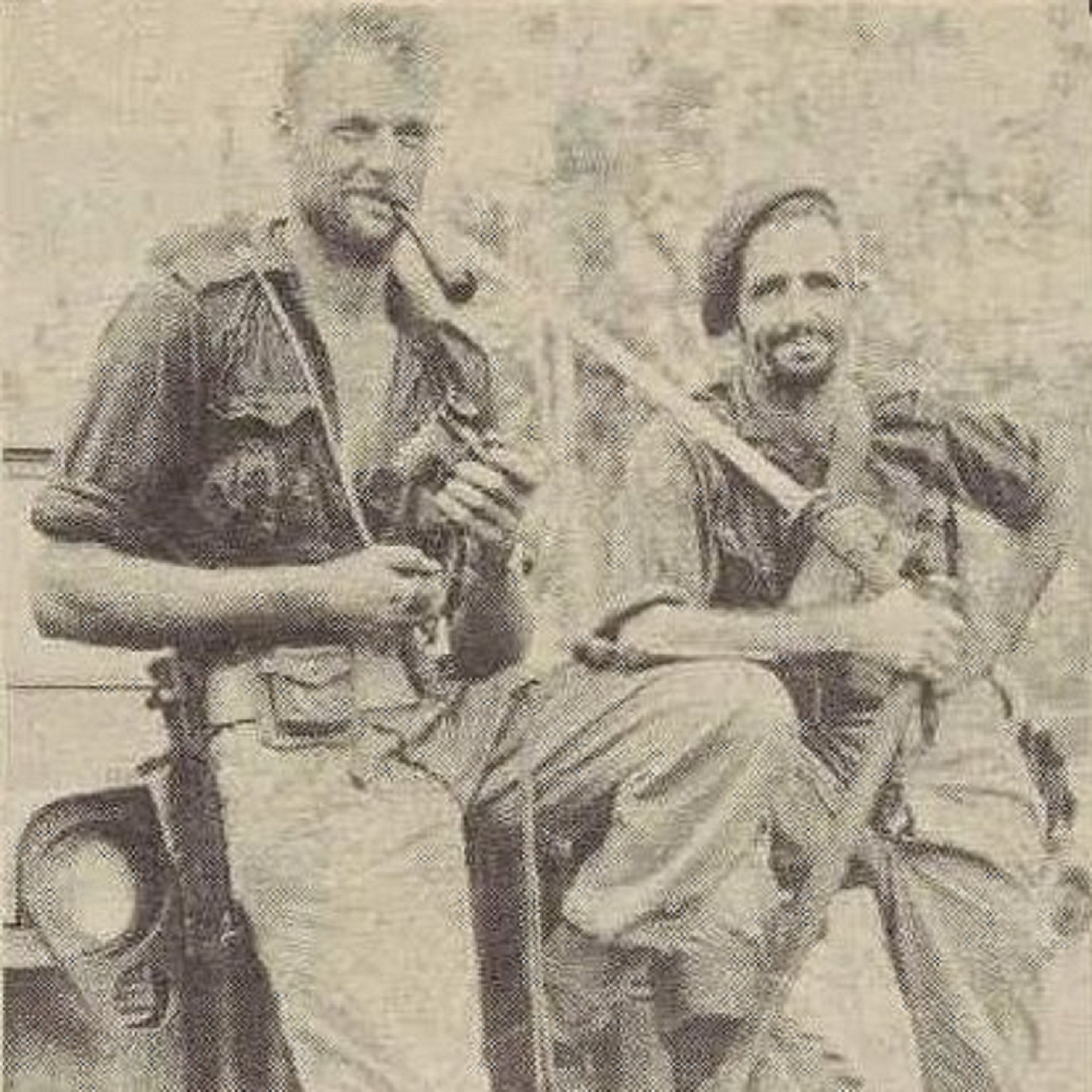
Cory and Tucker emerged from the jungle after two weeks thanks to the native commandos led by a coast watcher Lieutenant Paul Mason. And they ensured that they never had their photo taken before a mission ever again.
Shortly afterwards, Santa’s Christmas flight was repeated. This time by an RAAF bomber dropping gifts of appreciation to the villagers, including a toy dog, brightly-coloured floral calico, trousers, shorts, razor blades, barbers’ scissors, knives and jackets. Best of all was strong fishing line which the natives prized as strings for their most powerful bows.
After the war, Gil Cory went back to his property at Dalveen near Warwick, and Bill Tucker became a schoolteacher in Bundaberg.
Paul Mason became the most famous coast watcher of the war and was awarded the Distinguished Service Cross by both the Australians and Americans.
This was a Christmas story like no other.
CLICK HERE TO LISTEN TO A VERSION TOLD LIVE ON RADIO.
Photo credits:
World War II aeroplane monument on the island of Bougainville – Mining com.
Attaching gift-laden containers to the bomb racks on a Wirraway, New Guinea 1944 – Australian War Memorial 070126.
Gilbert Richard Isler Cory service record – National Archives of Australia A705 166 8 792.
RAAF News – 1st December 1984, page 14,
 History Out There