

The two miners found the richest gold reef in the world. But pandemonium reigned around them. I told a version of this story on West Bremer Radio.
This week I was in Yeppoon, central Queensland, and came across this amazing story. On the second of December 1937, police arrived on the beach at Yeppoon to find twenty-year-old Owen Weaber holding eighteen-year-old Valda Hayes in his arms. When questioned he could only answer hysterically, “I was going to Mount Morgan.”
Young Owen’s father was William Weaber from the Logan district south of Ipswich in southern Queensland. Weaber Senior went to Western Australia and became known as the “Blind Cattleman from the Kimberley” but come the 1930s he was making his fortune in mining. That’s because he sold his twelve thousand cattle in the Kimberley and set out with his wife and family in search of gold at Tennant Creek in the Northern Territory.
He joined forces with Jack Noble, who strangely had only one eye. With just one eye between them, the two searched ground that others had deemed worthless. They found a fabulously rich reef of gold. They turned down immediate offers of £50,000 which is more than $20 million in today’s money. Tennant Creek became the third largest gold producer in Australia.

Young Owen Weaber, the son of the now rich Blind Cattleman, had both of his eyes set on a different adventure and purchased a De Havilland DH 50 biplane. It had been used by Qantas on the Charleville-Cloncurry route.

He may also have had his sights set on the pretty Valda Hayes in Mount Morgan, which is south-west of Yeppoon.
Valda’s father was the formidable Mr James Hayes. He was the licensee of the Grand Hotel at Mount Morgan, and a former boxing and wrestling champion of Queensland and Victoria. He was also the world-record-holder for club swinging, having beaten the legendary Tom Burrows in Bundaberg. Club swinging is a sport in which you are given points taking into account the degree of difficulty of your swinging routine. It has actually appeared in two Olympic Games.

The young and ambitious Owen Weaber travelled to Queensland with his sixteen-year-old sister Kathleen, collected his new aeroplane in Brisbane, and flew to Mt Morgan to visit the Hayes family.
After a stay of ten days, Owen took off for Yeppoon. In the plane with him this time was Kathleen, as well as Mr Hayes, twenty-two-year-old son John Hayes who was a qualified pilot, and eighteen-year-old daughter Valda Hayes, who incidentally was the youngest female pilot in Queensland.
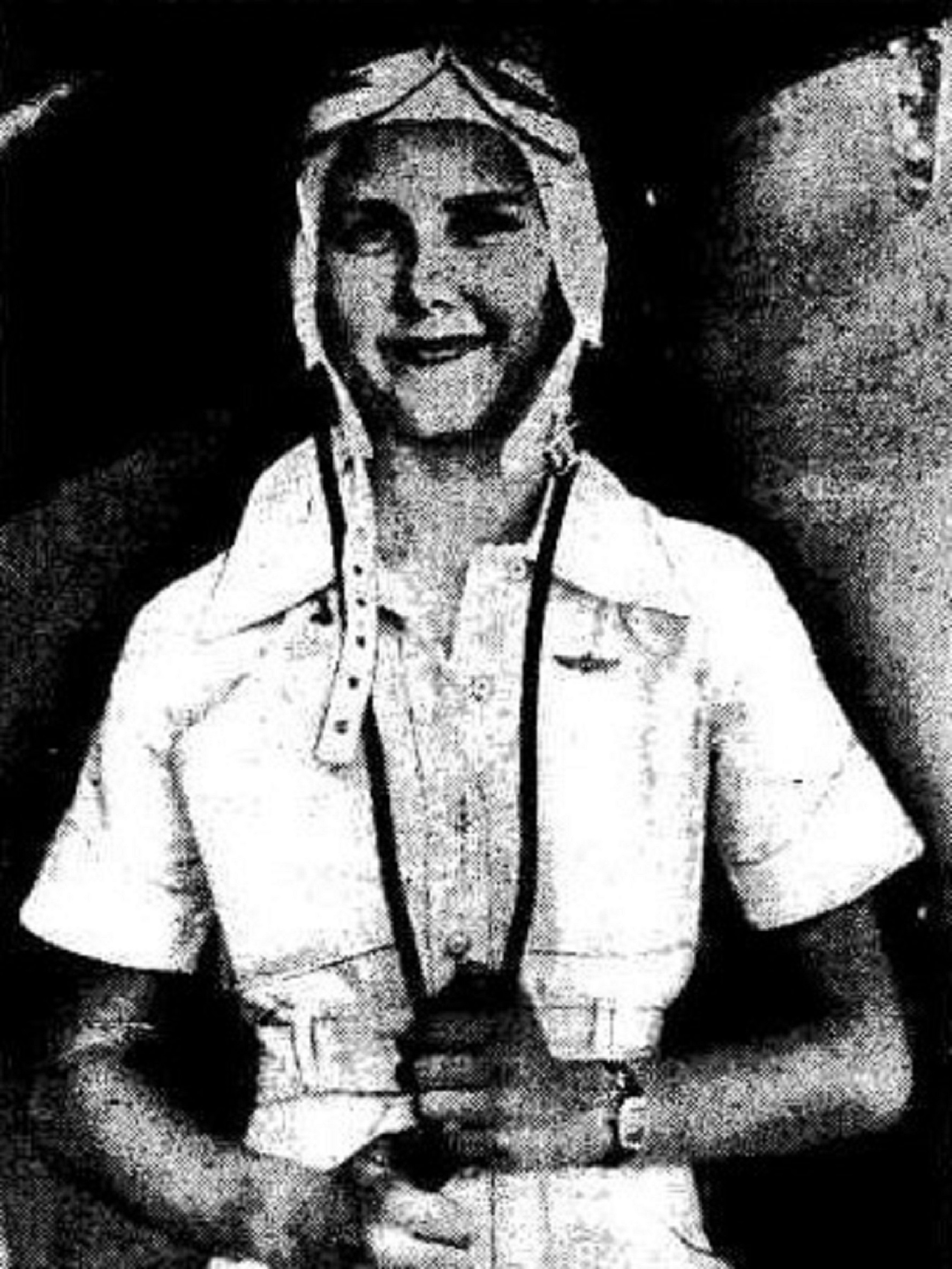
Having spent some time on the ground at Yeppoon, the group of five took off again. This time at a height of about one hundred and fifty feet the plane nose-dived, went into a spin, and crashed into the beach at Yeppoon.
Mr Hayes and his son John were killed instantly. The police arrived to see Owen cradling Valda in his arms. Both Valda and Owen’s sister Kathleen were pronounced dead after being taken to hospital. With four dead, this was the worst aviation tragedy in Queensland up to that time.
That wasn’t the end of the story. Three months later, Mrs Hayes, having lost her family, went on a trip to New Zealand. Avoiding air travel entirely, she was driven to Sydney by the crash pilot Owen Weaber who deposited her aboard the ship Awatea. Later with the outbreak of the Second World War in 1939, the ship was sunk by German aircraft.
Five months later, Owen himself boarded the ship Orama. He was going to England to join the Royal Air Force. That ship was also sunk by German aircraft.

In the meantime, William Weaber the Blind Cattleman died at Tennant Creek.
In the same month October 1940, his son Owen Weaber was flying with the RAF off the Norwegian coast. He was shot down and killed by German aircraft.
Mrs Weaber sold the gold mine and moved to be remaining family. But that was before the mine realised its full potential. Noble’s Nob, as their mine became known, went on to become the richest gold mine for its size in the world.

So this amazing story of five aviation deaths, two aviation sinkings, two miners with one eye between them, and one of the richest gold mines in the world, finally came to a close.
CLICK HERE TO LISTEN TO A VERSION TOLD LIVE ON RADIO.
Photo credits:
Hamilton sale yards, 2015 – Harold Peacock.
Jack Noble panning for gold – Age, Melbourne, 17th November 1954, page 9.
The DH50 that crashed – Courier-Mail, Brisbane, 3rd December 1937, page 17.
Mr J. J. Hayes – Central Queensland Herald, Rockhampton, 9th December 1937, page 58.
Miss Valda Hayes – Central Queensland Herald, Rockhampton, 9th December 1937, page 58.
Mr O. Weaber – Courier-Mail, Brisbane, 3rd December 1937, page 17.
The abandoned Nobles Nob Mine pit today – Wikipedia, by Tennisocourtland.
 History Out There
Owen’s mum Kathleen Weaber (nee Hayes) moved to Sydney with her youngest child Kevan who even at a young age (14) was tasked with ‘looking after his mum’ Kevan faithfully dedicated himself to this which included a trip to Stavanger Norway to visit Owen’s final resting place. Kathleen passed away in 1969 at Chatswood in Sydney, Kevan (1926-2010) had a marriage that lasted over 60 years to his devoted wife Thelma (2026-2018) and raised two very proud children with numerous grandchildren one who is currently well into his pilot training.
LikeLiked by 1 person
Let me correct Mum’s, Thelma’s age try 1926 to 2018.
LikeLike
The gold was discovered by Owen Weaber and four leases were pegged. The names of the 4 leases were Weabers Find, Kimberley Kids, Rising Sun and Nobles Nob. Nobles Nob was suggested by Mrs Kathleen Weaber as Jack Noble and old prospector had helped them peg the leases and they were former Cattlemen, as fate would have it Jack Noble did not discover Nobles Nob it is just the lease was named after him and many sources incorrectly credit him with the find. He never owned it.
LikeLiked by 1 person