

A man swapped his wife for a horse, the buyer wanted to swap back, they all ended up in court and guilty of cruelty to horses. I told a version of this bizarre true story live on West Bremer Radio.
In 1857 a husband and wife appeared in the Brisbane courthouse. On a Monday, David Ferguson was found guilty of drunkenness and sentenced to 24 hours solitary confinement. On the Wednesday, the wife Agnes Ferguson was fined for drunkenness and obscene language.
This was a couple made in heaven. You see they were both convicts. David Ferguson was transported to Australia from Norfolk, England, in 1834. And Agnes, she was transported from County Cork, Ireland, in 1839, and while her first husband was in prison, she bigamously had married Ferguson.
While this love match was regularly in the Brisbane court, in the Ipswich courthouse in 1859, there were twin brothers matched against one another. The case of Moses Walmsley versus Aaron Walmsley was adjourned and sadly the outcome has been lost in history.

The Walmsleys came from Liverpool, England, in the early 1850s. Moses got married in Ipswich to the daughter of a Mr. Samuel Pitt after whom Pitt Street in Sydney was named. Moses ran a dairy farm at Redbank, today a suburb of Ipswich, and his twin brother Aaron became a shipwright.
There were signs that the convict Ferguson marriage was in trouble when in March 1860, David Ferguson advertised in the Moreton Bay Courier newspaper warning the public not to give his wife Agnes any credit, because he would not be responsible for repayment. In June that year, the Fergusons and the Walmsleys were back in court, this time in Brisbane against one another.
Aaron Walmsley charged David Ferguson with unlawfully detaining a set of harness, horse, and cart, which Walmsley claimed belonged to him. Walmsley was represented by none other than Charles Lilley who was destined to become the premier and chief justice of Queensland.

The circumstances of this case were quite bizarre. Ferguson had agreed to sell his wife Agnes in exchange for Walmsley’s horse, cart, and harness. The actual signed contract was provided to the court.
The written agreement entered into was read verbatim and reproduced here with the original spelling: “I have this day sold agnas oclong – April 10th 1860. I have sold my wife for a hors and dray, branded on neer shulder vey thing complet. – it is now fagsuns hors and dray vey thing complet. – a dark brown hors (signed). Aaron Walmsley;” and some other name we could not decipher.
As a result of the contract, Ferguson took possession of the horse and gear, and Walmsley took possession of the wife. After living with her for some time, though, Walmsley found that the deal wasn’t quite as he’d hoped, in that his acquired wife was seldom or rather never at home with him. For this reason he wanted to get his horse back, and return Agnes.
However, in court the future premier Lilley pointed out that the contract wasn’t actually legal and so couldn’t be admitted as evidence by Ferguson, who was desperate to keep the horse rather than the wife. The bench agreed with Lilley and so ordered the restitution of the horse and dray – and the wife.
The following week everyone was back in court again. Presiding were Brisbane’s first mayor John Petrie and magistrate William Brown. This time Agnes Ferguson charged sometime-husband Aaron Walmsley with assault. Agnes claimed that Walmsley had struck her on the arm with a tomahawk and in the neck with a knife. Much to the embarrassment of the learned magistrates, Agnes bared her arm and offered to expose other parts of her body as evidence, but the bench quickly deemed that as unnecessary. In the end, the case as dismissed.

Without even leaving the courtroom, Walmsley then again charged Agnes’s other sometime-husband Ferguson with unlawfully detaining his horse. But because the horse and wife had already been returned, that case was also dismissed.

Strangely it seems Agnes and Walmsley maintained each other’s company. Just weeks later in August 1860, Agnes was back before magistrate Brown. This time she was charged with assaulting an old man after she dragged him out of bed by his shirt and tore it off over his head. She then kicked him whilst he was on the floor. Walmsley joined the fray and struck the man about the head with a largo stick, and as a result, matter had flowed from his ears ever since. Agnes was sentenced to one month’s imprisonment, and Walmsley to six weeks.
The Fergusons and Walmsleys continued to keep the courts busy. Aaron Walmsley, the man who swapped his horse for a wife, was ironically found guilty of mistreating his horse.
Twin brother Moses Walmsley, who took Aaron to court in Ipswich, was also found guilty of cruelty to a horse.
William Walmsley inherited a difficulty with horses from both his father Moses and uncle Aaron. He wreaked havoc on Stanley Street in South Brisbane when the horse he was riding threw him off; it then collided with a horse and cart which bolted and threw out its three passengers; that horse and cart then collided with a horse and dray, which threw two more men to the ground.
As for Agnes Ferguson, she was admitted to the Dunwich benevolent asylum on Stradbroke Island in Moreton Bay and died there in 1893. She was buried in an unmarked grave. And that’s what happened to the wife who was swapped for a horse and cart.
CLICK HERE TO LISTEN TO A VERSION OF THIS STORY TOLD LIVE ON WEST BREMER RADIO.
Photo credits:
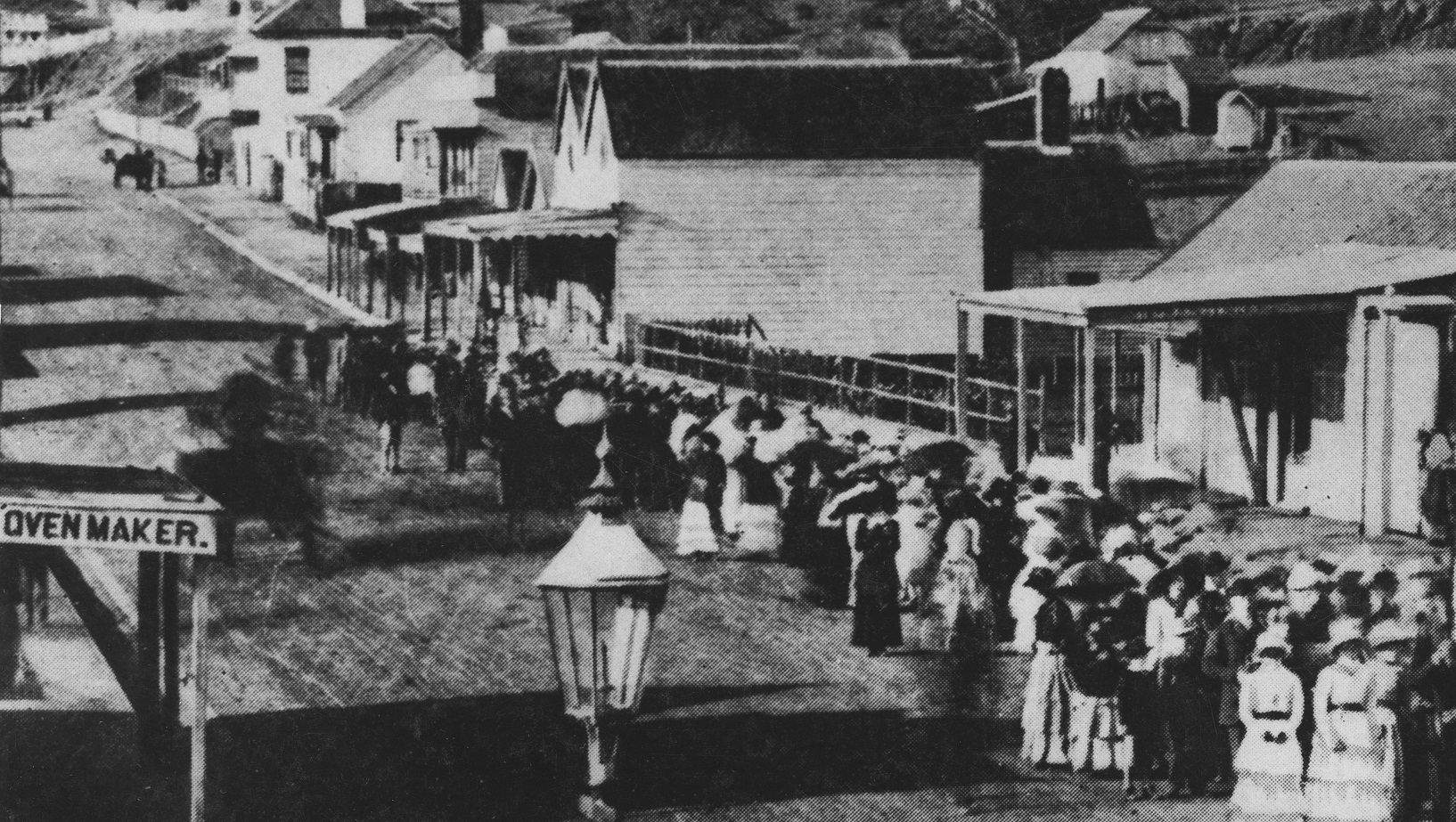
Queen Street, Brisbane, c1859 – State Library of Queensland.
Moses Walmsley – State Library of Queensland.
Charles Lilley, 1858 – State Library of Queensland.
John Petrie – State Library of Queensland.
William Anthony Brown – Find a Grave uploaded by Just Jack 2019.
Stanley Street, South Brisbane, c1887 – State Library of Queensland.
 History Out There