
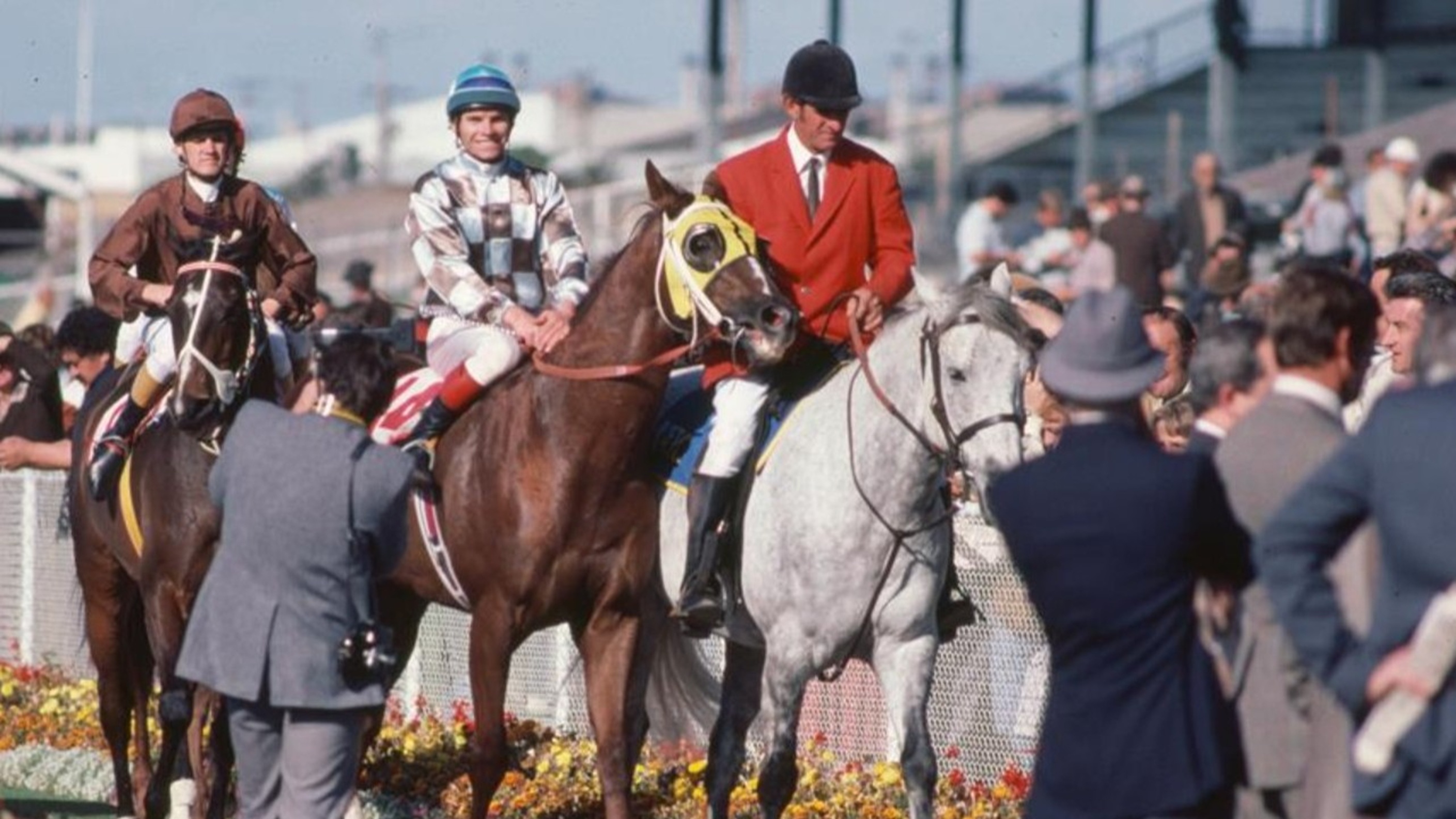
In a horse racing special, here’s the story of Queensland’s first doyen of racing. I told a version of this story live on Darling Downs radio 4AK.
Mr. John Finnie was the Father of the Queensland Turf, the Doyen of Racing in Queensland, and the Squire of Drayton. Finnie was born in Scotland in 1839, died at his home at Drayton, Toowoomba, in 1921 aged eighty-two, and in between times created a national legacy that should be more widely known.

When Finnie first arrived in Queensland as a youngster, he started work as a shepherd on Pilton Station near Allora. He went to Drayton and started a carrying business between there an Ipswich. After some time he acquired land at Rosevale, engaged in mixed farming including dairying and produced Finnie’s brand of butter. He got into breeding and stock raising, and became noted as a breeder of horses, both draughts and bloodstock and his Rosevale Stud was born, becoming famous throughout Australia.

As a breeder and owner of racehorses Finnie became extremely well known both in Queensland and the southern states, where for over half a century his racing silks of a yellow jacket and black cap were carried by hundreds of winners.
Megaphone was the best horse of hundreds that Finnie bred and was the marvel horse of his day. Megaphone started eighteen times as a two-year-old which was a remarkable quantity, and I believe still holds a record that will never be broken.

Six times across three states, including four in Queensland, and one each at Randwick and Flemington, Megaphone raced in two races on the same day, always against the best horses in the state. He won five of those single-day doubles, and covered himself in glory in the sixth when only beaten by the legendary Carbine by less than a length in record time. Megaphone was bought by the owner of Carbine and ran him to a head in the A.J.C. Craven Plate in 1891. During his career Megaphone won at all distances, from five furlongs to three miles.
But Finnie didn’t make his name with just one wonder horse because his horses won races in every state in Australia.
As far back as 1877 Finnie’s name first appeared as the winner of a bigtime race, the Q.T.C. Moreton Handicap with Nemo. Finnie won that same race nineteen years later in 1896 with Newbold which was the stallion that ultimately put Finnie’s stud on the map.
Finnie won the Brisbane Cup first with Sydney in 1876, and later with Lurline in 1891 and with Black Paint in 1911. The St. Leger he won with Medusa, the Stradbroke Handicap with Sweetheart and Gold Tie. He won the Queensland Cup with My Love in 1885, the Sandgate Handicap twice in succession with Sydney 1879-1880, and later with Kalmia in 1898. In 1882 Goldfinder, which won 26 races out of 31 starts, won him the Queensland Derby, and in 1886 he won the Hopeful Stakes with Rose. And the list goes on.
Another horse was Ben Bolt that won Finnie the Caulfield Cup in 1886. The Queensland horse was leased to a Victorian who in 1888 implicated him in a £4,000 or $4 million fleecing of Queensland punters in the lead-up to the Melbourne Cup. He was run dead prior to the Cup to boost his odds to 100-1 but finished 14th. And that’s something that Finnie himself would never do.

You see, what made Finnie unique in the racing game was that he was universally respected for his frankness and integrity. So much so that he was genuinely known as “Honest John”.
And Finnie was not a betting man. He ran his horses for the honour and glory of winning the prize, which is something to be admired today.
So John Finnie, the doyen of Racing in Queensland, can teach us something today on Melbourne Cup day, that you can have fun and enjoy the race with necessarily having to drink and gamble. Honest John Finnie had it nailed, and he was the greatest racing man of his day.
CLICK HERE TO LISTEN TO A VERSION OF THIS STORY TOLD ON RADIO 4AK.
Photo credits:
Horse Racing at Doomben, Brisbane, 1983 – National Archives of Australia.
John Finnie the doyen of racing in Queensland – Sports Referee, Brisbane, 25th June 1921, page 2.
Pilton Head Station near Allora, Qennsland, 1909 – Aussie~mobs via Flickr 2021.
Racehorse Megaphone, 1890, J.F.C. Farquhar photographer – State Library of Victoria.
Ben Bolt winner of the 1886 Caulfield Cup – State Library of Victoria.
 History Out There