
There’s a remarkable story of German Anzacs fighting for Australia during the First World War. From the hometown of one of those men I told a version of the tale on West Bremer Radio.
Kalbar in the Scenic Rim, Queensland, is not the first name this place has had. Initially it was Fassifern Scrub but then called Engelsburg because from the second half of the nineteenth century it was settled almost exclusively by Germans.

But come the First World War, anti-German sentiment in Australia was rife. And so in 1916 Engelsburg was given its third name when it was changed to Kalbar which of course it is today.
But Kalbar wasn’t the only place to have its name changed. In fact, at least ninety-one German place and district names in Australia were changed. South Australia made the most with sixty-nine changes. In Queensland there were at around fourteen changes, many of them within a comfortable horse ride of Engelsburg. Even King George V changed his name from Saxe-Coburg-Gotha to Windsor.
Some of the changes followed a patriotic theme. Like Haigslea just outside of Ipswich. It was originally called Kirchheim. It was re-named Haigslea after General Douglas Haig who was the commander of the British Army in France.
Some changes didn’t make sense. Like Mount Mort just north-west of here. It was originally Gehrkevale. But in 1916 it was renamed Mount Mort, even though there’s no mountain there.
And one place actually reverted to its original name. Minden was originally called Back Plains or Rosewood Scrub. In 1916 Minden was changed to Frenchton. But it was changed back to Minden in 1930 ironically just in time for the next war against Germany.
But in my mind history is always best told by stories about individual people.
When the First World War was declared in 1914, the children of the settlers here were faced with a dilemma – fight for the pioneering country in which they were born, or side with the old European power from where their parents came and still talked about over the kitchen table.
Eighty-seven men from the Engelsburg district enlisted to fight for Australia. They made a clear choice of loyalty to Australia, even though they knew the high casualty rate, and that it meant potentially killing their German cousins.
One of those Australians was Alexander Krueger who was a timber cutter from the beautiful Fassifern Valley in which Engelsburg is nestled.
Alex was born in Fassifern on the 24th of October 1886. He was the oldest of seven children born to Prussian immigrants Ferdinand Fredrich Wilhelm Krueger and Mary Emily Korner. The family farm was at Charlwood, six miles south of Engelsburg. As soon as Alex was old enough, he moved into town where his father was a cornet player in the Baptist church band, and his uncle was the pastor.
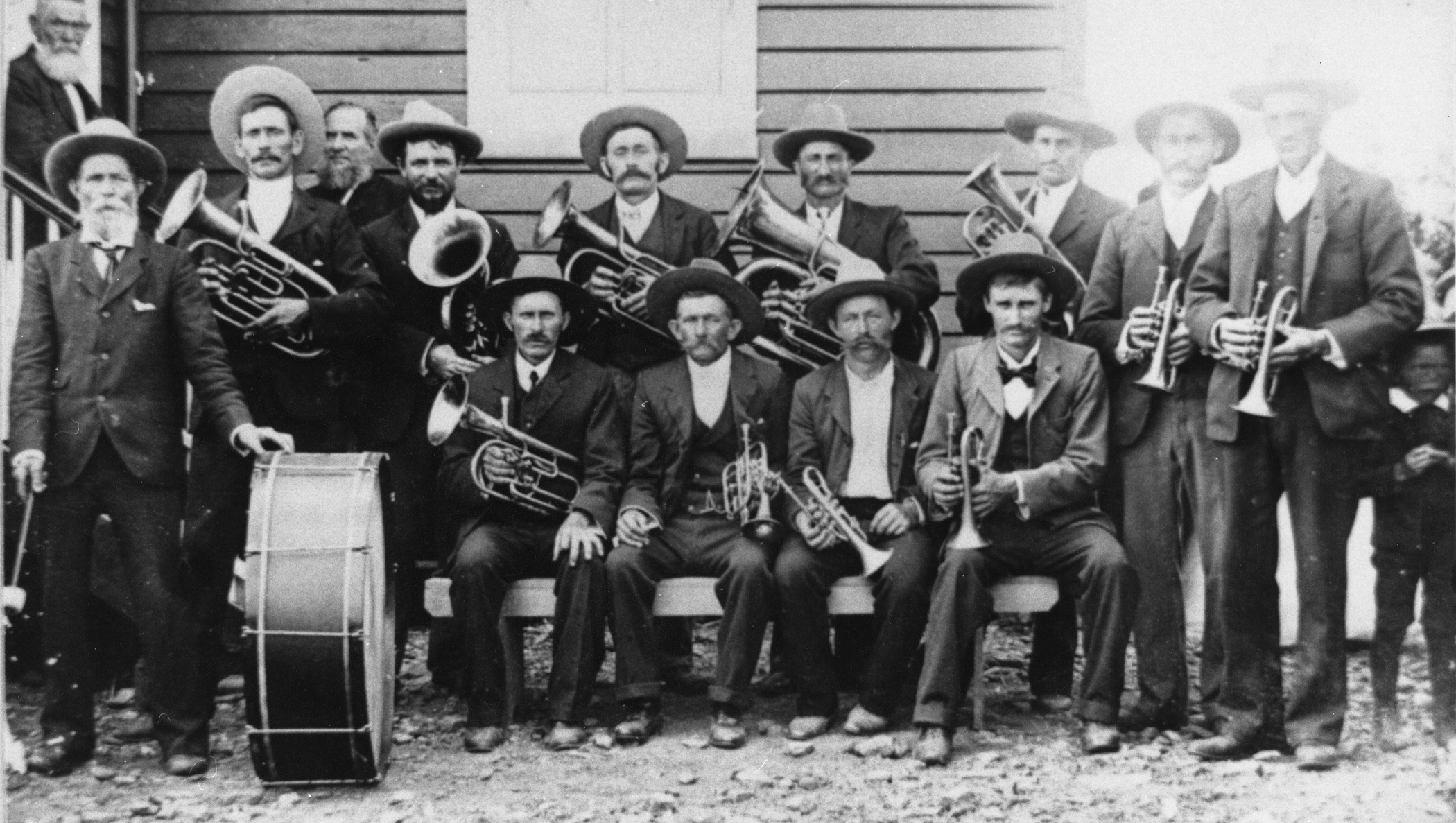
In 1916 with the casualty lists growing, Engelsburg was renamed Kalbar, and Alex signed up for the Australian army. He joined the 25th Battalion which was known as the Darling Downs Regiment.
His first major engagement was the battle of Menin Road in Belgium. It was an Australian victory and Alex survived without a scratch.
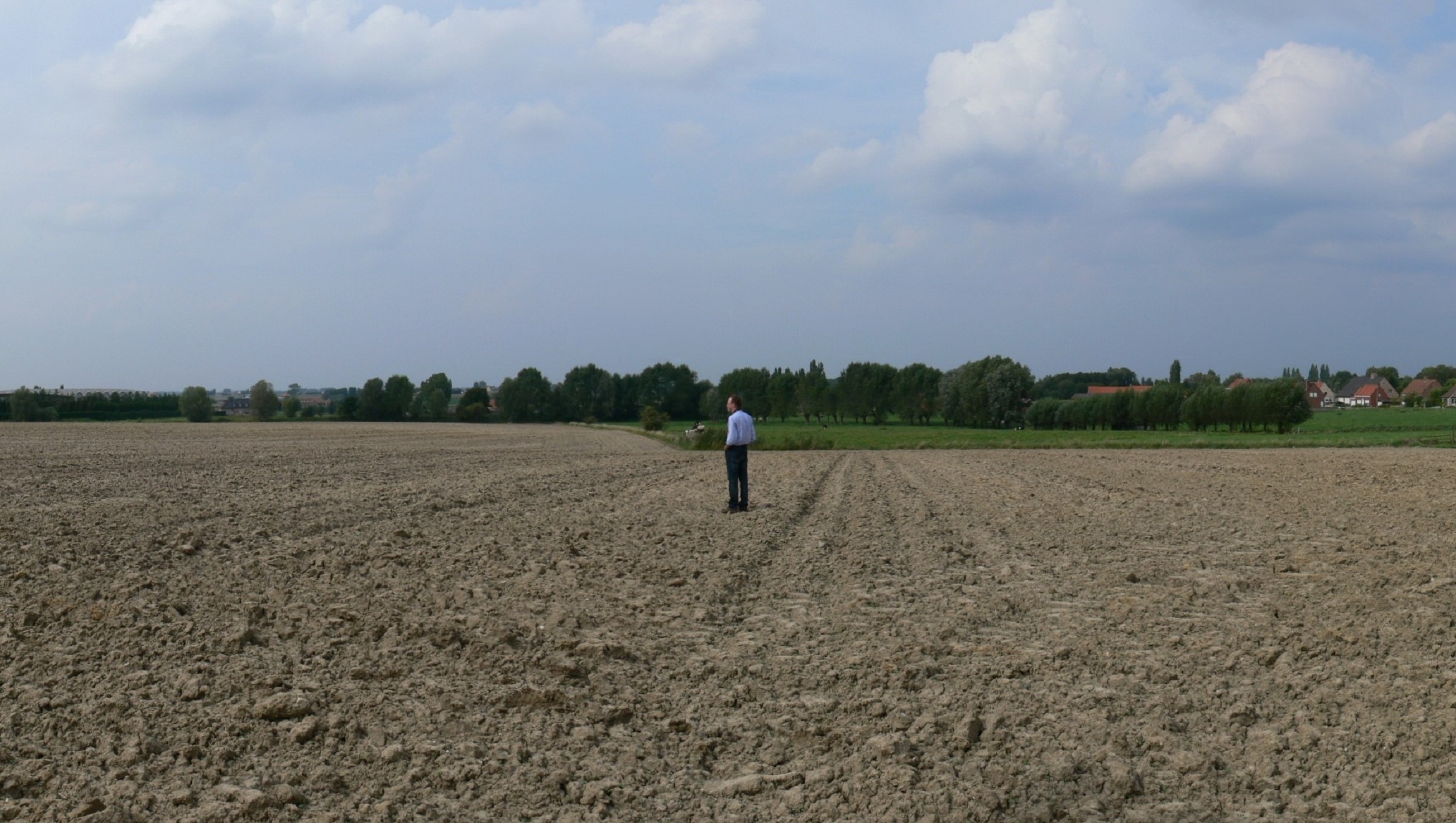
Then came the Battle of Broodseinde Ridge on the 4th of October 1917. (The battleground is pictured at the top of the page.) That’s when the impossible happened – both the Australians and the Germans co-incidentally emerged from their opposing trenches to attack at the same time. The result was bitter hand-to-hand fighting. It was another Australian victory but 1,279 Australians died that day which was the deadliest day in Australia’s military history. During the mayhem, Alex fell, he’d been shot through the lungs. He lingered for two days before dying seventeen days short of his thirty-first birthday.
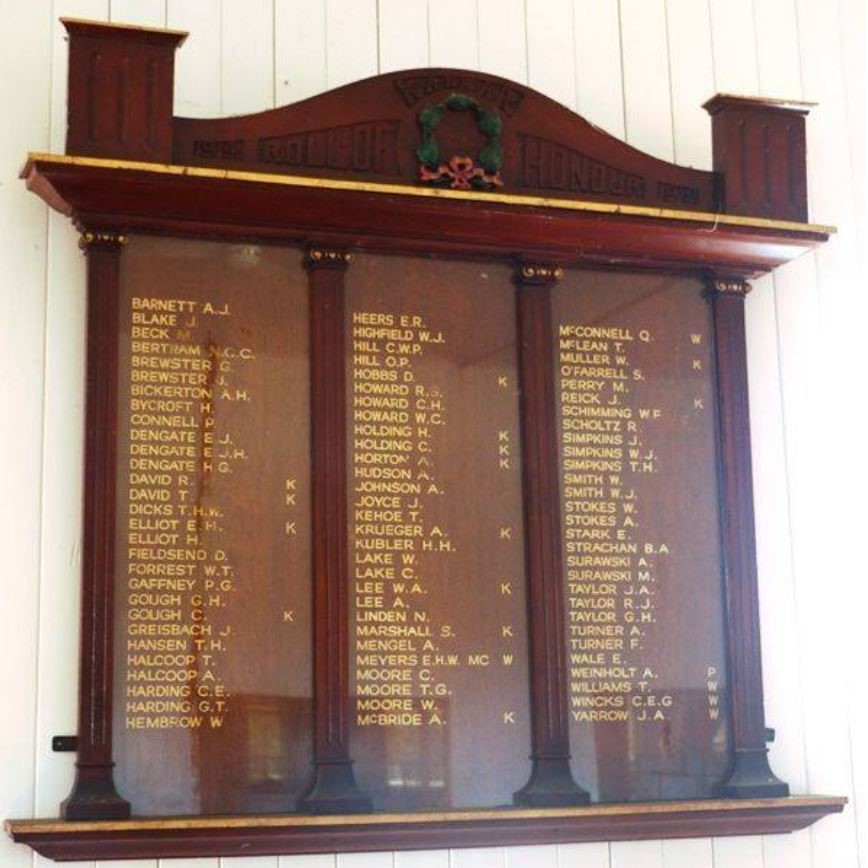
Today Alex’s name is on the honour board at the Kalbar School of Arts. But that’s not the end of his story.
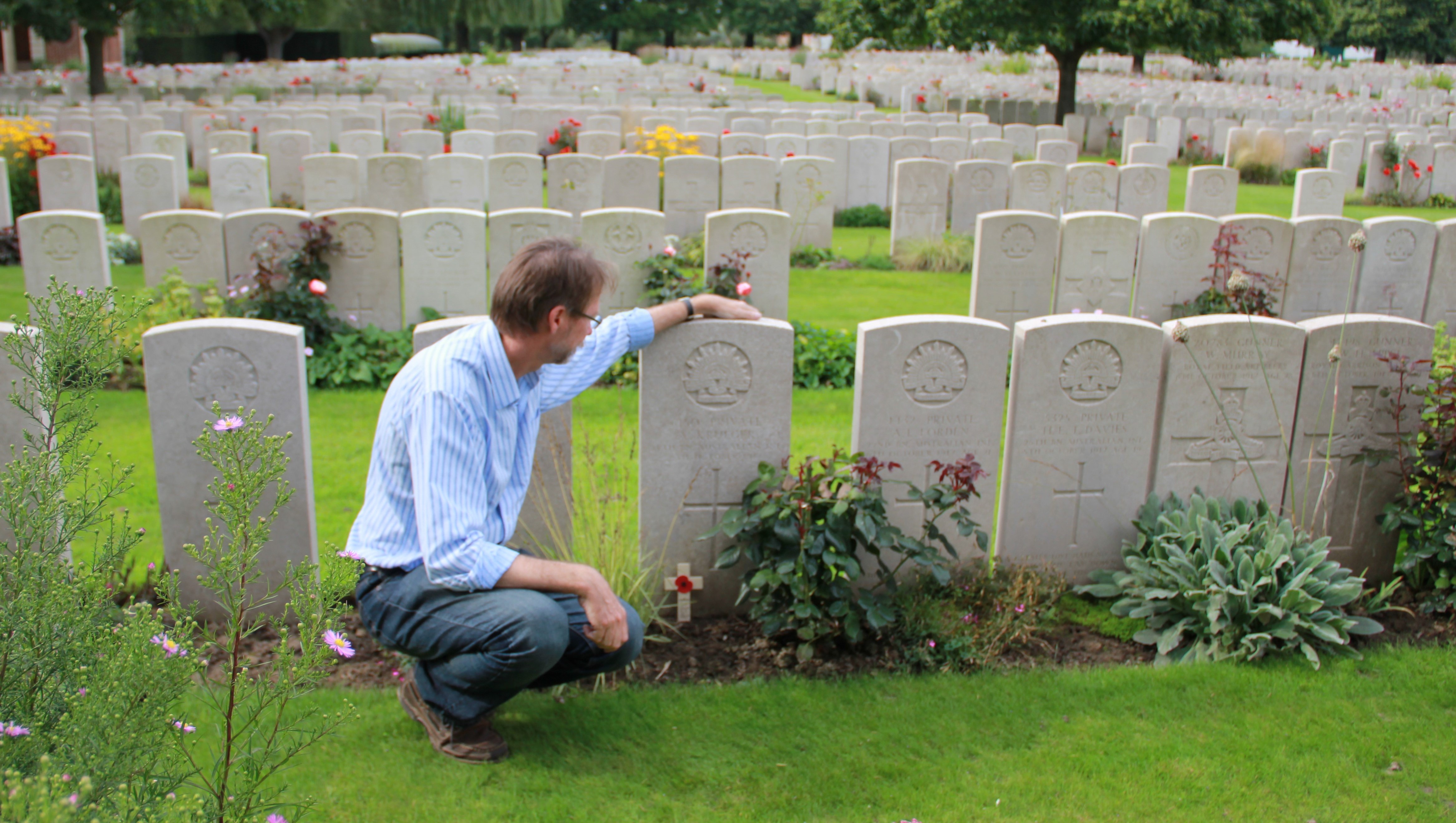
You see, almost a century later, the Brisbane architect Darren Dickfos found out about his ancestor and became the first relative to ever visit Alex’s grave in Belgium. Darren placed a small wooden cross on the gravesite, with a hand-written inscription saying, “Know that you are missed.”
That applies to all the Anzacs who were lost from Kalbar and everywhere. Remember them all this Anzac Day on April 25th.
CLICK HERE TO LISTEN TO A VERSION OF THIS STORY TOLD LIVE ON RADIO.
Photo credits:
Panorama of Broodseinde Ridge Belgium – Darren Dickfos 2011.
Royal Hotel Kalbar 2021 – Harold Peacock 20210919_122134.
Engelsburg Baptist Church Band 1907-1914 – State Library of Queensland.
Kalbar Roll of Honour – Monuments Australia.
Darren Dickfos visits Alexander Krueger grave Belgium 2011 – Darren Dickfos IMG_1620.
 History Out There
That’s a great bit of history, that isn’t so well known. Many families in the Fassifern District were of German origin, but chose to fight for their new homeland. Thank you for sharing.
LikeLike