
Throttling, strangling, and nulla nullas were dangers to be avoided in early football matches. Hopefully the footy finals on now are safer. I told a version of this story live on radio 4WK.
Some form of organised football has been played in Australia for at least one hundred and seventy years, and it’s always been considered a wee bit dangerous.
The first football death in Australia quite possibly happened in Queensland in the North Burnett region in 1862. A young Aboriginal boy called Namoi was running after the ball during a game of footy. He fell and the pointy end of his nulla nulla went through his eye and killed him. There was some suspicion about the accuracy of the facts however.
Then there was a death reported in Brisbane in 1876 of a young man by the name of Sydney Branson. News coverage highlighted the safety aspects in some of the rugby laws at the time.
These included rules like:
“It is lawful hold any player in a maul, but this holding does not include attempts to throttle or strangle.”
“No player may be hacked (kicked on the shins or legs) and held at the same time.”
“No one wearing projecting nails, (or) iron plates… on the soles of his boots or shoes shall be allowed to play.”
Safety was being indeed taken seriously even back then.
A particularly heart-wrenching fatality was the first football death on the Darling Downs, Queensland, in 1919. That’s when twenty-one-year-old Claude Fitzgerald died after sustaining a head injury on the football field. Fitzgerald was a prominent all-round athlete in Warwick.
Fitzgerald and his mother lived at the upper end of Palmerin Street. He was the youngest son, and the only one to stay at home while his three older brothers went off to the First World War. All three were also prominent sportsmen. One was Joe “Cyclone” Fitzgerald who was a champion boxer, and whose son would become Warwick’s first Olympian.

The sympathy of the community was immense because it seemed unfair for the mother that at a moment when her life should be filled with joy at the safe return of three soldier sons, that the youngest lad who “kept the home fires burning” should pass away under such tragic circumstances.
The swimming trophy Claude Fitzgerald Memorial Cup was named after him. It was for a handicap event, the only one in which juniors and seniors were allowed to compete together. And as late as the 1950s the Claude Fitzgerald Grandstand was a feature at the Warwick swimming baths.
Fitzgerald’s grandfather Charles Wills owned the Royal Hotel at Allora. Wills was a convict and a notorious thief from Warwick in England. He was arrested as a nineteen-year-old for stealing silver coins, silver spoons, a gold ring and brooch, and silk handkerchiefs, and transported to Australia for seven years.
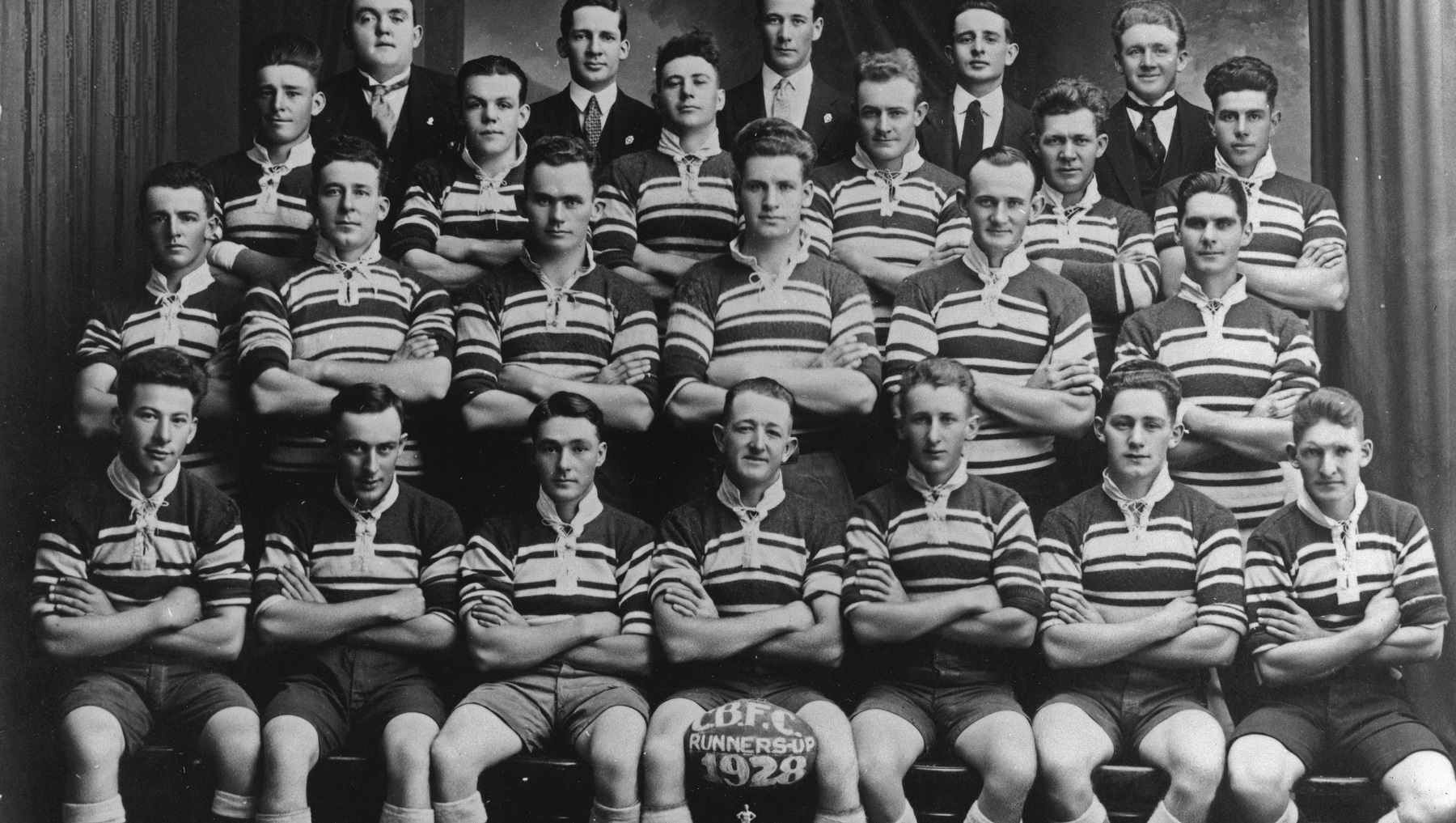
Perhaps the first grand final football death came one hundred years ago this month. It was on the 7th of September 1924 with the death of Harold Mole. He was a twenty-three-year-old full-back for Warwick’s Wallaroos football team against Warwick’s Christian Brothers (1928 team in the photo top of page) in the final match of the season. Mole played his best game of the year to lead his team to the win and the premiership. But he picked up a head injury during the match and died from a brain haemorrhage the next morning.
Cheer for your favourite team but be thankful that we now have better rules than in the nineteenth century when it was necessary to explicitly outlaw throttling and strangling, and nulla nullas were quite legal.
CLICK HERE TO LISTEN TO A VERSION OF THIS STORY TOLD ON RADIO 4WK.
Photo credits:
Christian Brothers Football Club Warwick runners-up 1928 – State Library of Queensland.
Fitzgerald brothers A.K., C.J., and J.F. Fitzgerald – Toowoomba Chronicle, 28th February 1918, page 5.
 History Out There