
New Year’s has never been big in Ipswich, and here are some of the dullest. I told a version of this story live on Ipswich’s West Bremer Radio.
New year’s in 1918 was just another quiet day in Ipswich. The only news was about the weather being positively unpleasant to be outdoors. But what was unique about 1918 was that it was the start of last year of the First World War. The public holiday was a blessing of sorts because it allowed large crowds of Ipswich people to be at the railway station to welcome home another big batch of returned invalid soldiers.
New year’s day in 1945, which was the start of the last year of the Second World War, was a little different because by then new traditions had been established. One tradition was that when the post office clock struck midnight, a railway engine somewhere in the distance sounded its whistle. Another tradition was that everyone left town. Trains were packed leaving Ipswich in the morning, followed by a steady stream of sunburned locals coming home at night, that’s because everyone went to Sandgate. The other big tradition was that after midnight, ribald remarks were written using soap on shop windows.

But it was all pretty boring, especially some of the between-the-war years.
For example for the 1929 new year, there was no difference between that and any other night in Ipswich. The cinemas attracted their crowds, but everyone went straight home, cafes stayed open only another half hour or so, and a rainstorm sent any loiterers running. At midnight, the post office clock stuck twelve, a few straggling fireworks went off, and the only people in the streets were police who were there to control no one. Soap writing had begun with one practical joker tamely scrawling “1929” on a window. But what was really exciting was that a couple of the banks celebrated by balancing their books, and lights in their offices showed accountants excitedly toiling away at midnight.
For 1930, new year’s in Ipswich was duller than normal. Even the people who left town, they came home early because of the rain. The only excitement was that a two storied house and shop in Blackall Street, Basin Pocket, was completely destroyed by fire in the early hours of the morning. It was owned by Mrs Mary Ann Dwyer who earlier had complained to the mayor about the bad state of her street, but Mrs Dwyer had the foresight to insure her home for £1,500 by using four insurance policies. Her neighbour was Mr August Jaenke, a retired farmer, whose wife had taken the unusual step of obtaining a court order to stop him from drinking alcohol for a year.
For 1931 nothing happened, other than the usual mass exodus from Ipswich in sweltering weather.
New Year’s Day in 1932 was more of the same with the blowing of a train whistle and another mass exodus. There were 300 train tickets sold in the morning, so many in fact that two special trains had to be put on. The only excitement was that Mr Charles Milne, a thirty-six year old married man of Walsh Street, was riding his bicycle when he collied with a motorcycle.
For 1933, the tolling of the town clock and one or two random crackers were the only audible evidence that a new year had dawned. It was one of the quietest Ipswich new year’s on record.
For 1934, the new year was again ushered in with scarcely a sound. There were the railway whistles, a half-hearted cracker or two, and some city shop windows were disfigured with soap. But other than that, it was unbearably hot and muggy. And so it goes on.
The next time you find yourself alone on a new year’s eve, you’re probably having a pretty exciting time based on historical Ipswich standards.
CLICK HERE TO LISTEN TO A VERSION OF THIS STORY TOLD ON WEST BREMER RADIO.
Photo credits:
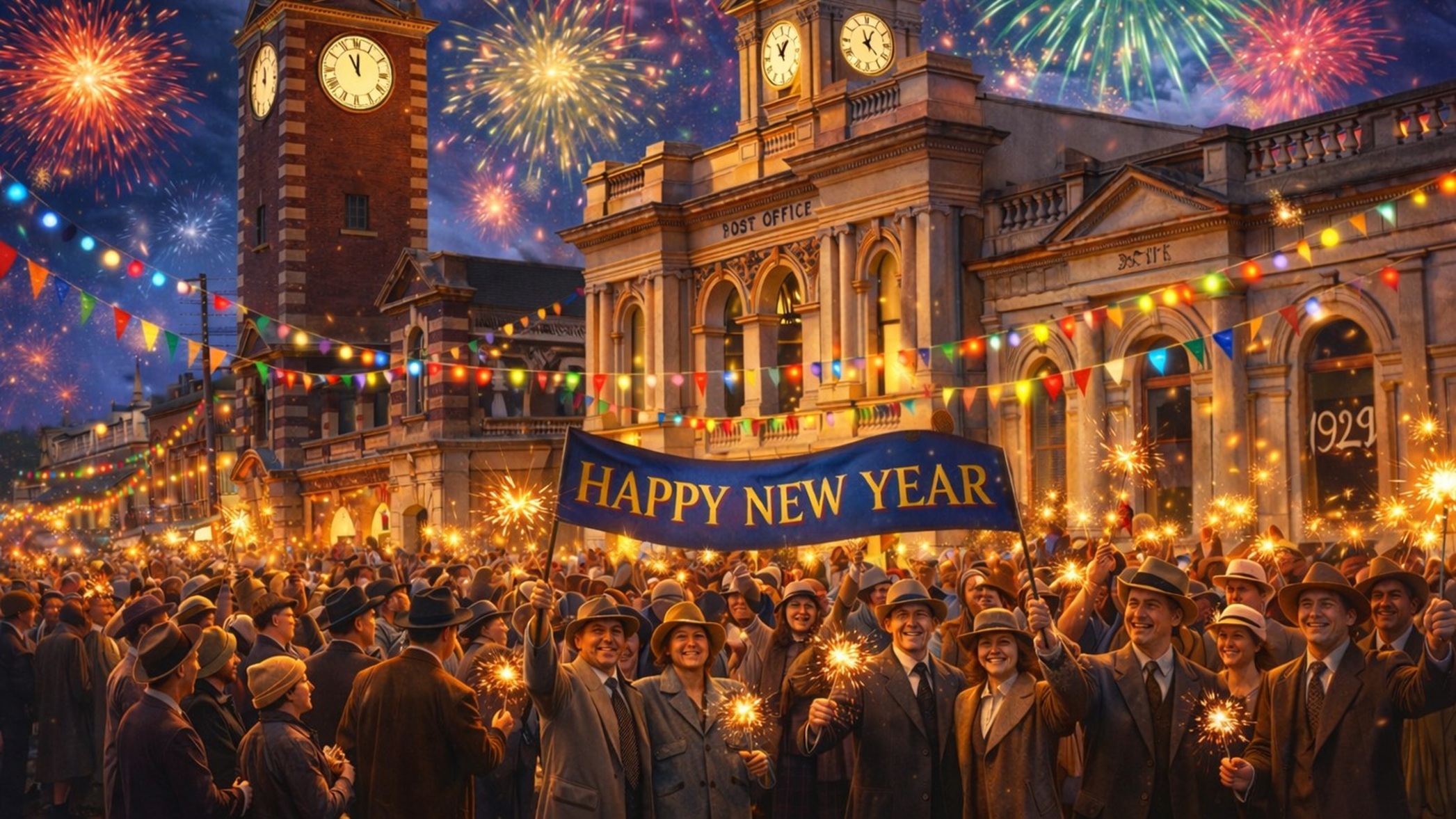
Representation of New Year’s in Ipswich – ChatGPT Image.
Ipswich post office, town-hall, and Bank of Australasia c1902 – Ipswich City Council.
 History Out There